
2024 Message from the President

In the 2024 end-of-the-year message, UArctic President Lars Kullerud talks about UArctic's collective knowledge and the network's potential to deliver on its intended impacts.
"UArctic members are evenly spread across regions: a third in North America, a third in the Nordics, and a third in non-Arctic countries. Without the pause in membership, an equal portion would be engaged in Russia. Put together, our member institutions consist of millions of students and almost half a million faculty and staff. Not all of them care about the Arctic specifically, but a big percentage does, and in the northern institutions that number is likely closer to 100%.
Currently UArctic has 65 Thematic Networks and Institutes that engage more than 1,000 researchers and experts. They form the backbone of the implementation of our activities together with 25 UArctic Chairs. We also have a vibrant and growing north2north mobility program at the core of our education activities. Many of these activities are funded by national governments, and in fact, just a few weeks ago, we received the good news that the UArctic funding from Denmark is going to be doubled. This means we will have stable funding of roughly one million dollars per year from Denmark, Canada, and Norway.
Now, imagine that all Arctic knowledge in different knowledge systems is like a big pool. The collective knowledge of UArctic Thematic Networks forms a large part of this. Add to that the 25 UArctic Chairs and the eight UArctic Fellows, as well as the expertise of all UArctic members. Together, this makes our network's knowledge quite comprehensive; it is unquestionably the major source of academic competence in and about the Arctic. This can be substantiated by the fact that close to all university-level education and approximately half of all research published about the Arctic comes from UArctic member institutions. The other half of Arctic research is mostly done by government agencies.

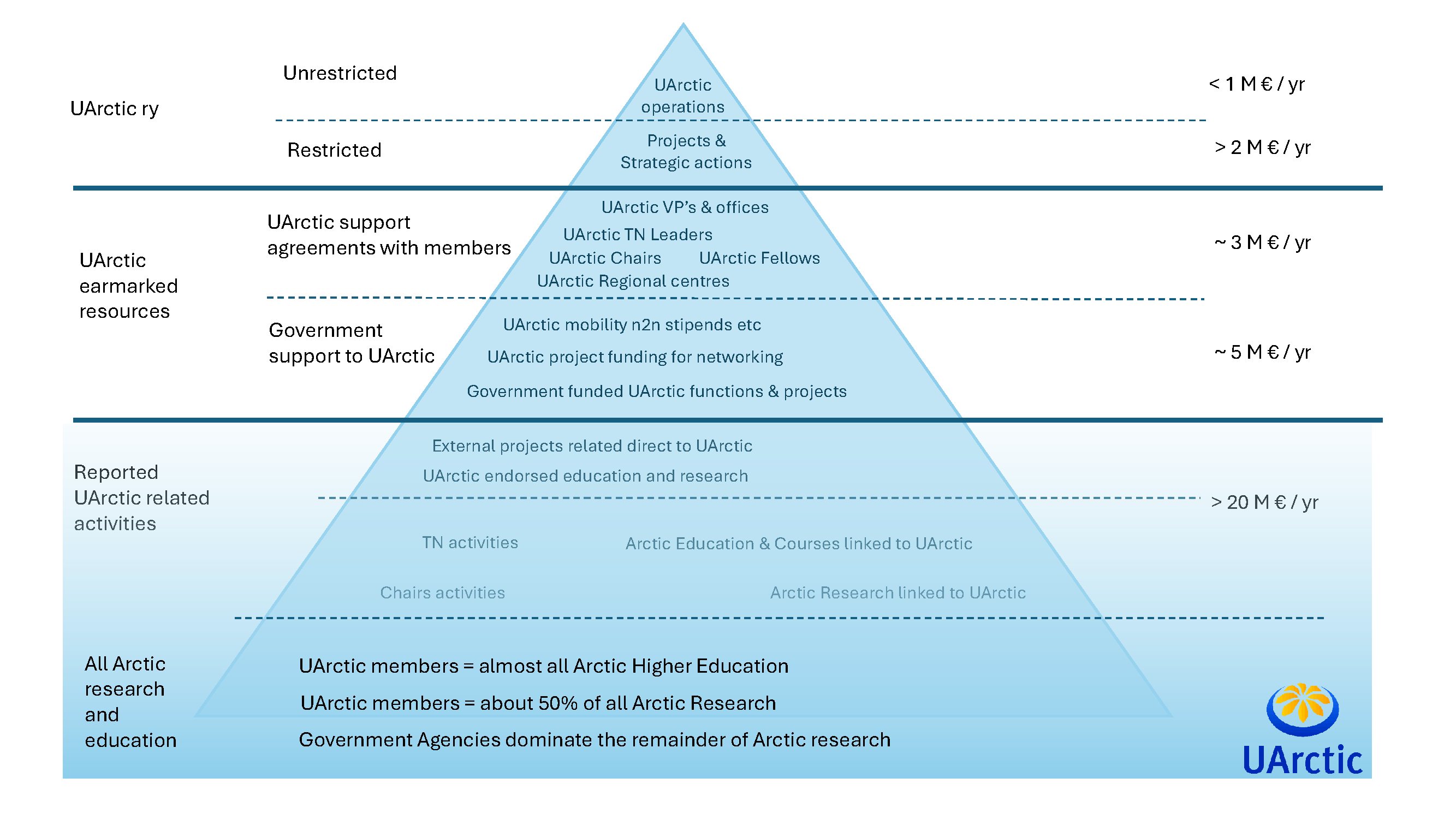
Although UArctic is a small organization with a small economy, it has enormous potential. The legal entity UArctic ry, or UArctic Association, only manages a few million euros per year, but that is just the tip of what we call the finance pyramid. Most of UArctic staff and leadership, the leads of Thematic Networks, and all UArctic Chairs have agreements with some financial commitment from their host institutions. That money does not flow through UArctic, and the total sum is bigger than the money we control centrally. Further, the government funding towards UArctic that stimulates collaboration between Thematic Networks and Chairs and also enables northern mobility – another important earmarked resource for UArctic – is also not directly controlled by the network, but we are part of deciding on how the funding is used and who receives it. This middle part of the finance pyramid, meaning the funding that makes UArctic activities possible but is not controlled by UArctic, together forms a much bigger portion of our actual economic value than the little tip of the pyramid. Below all of this, forming the base layer of the finance pyramid, are the activities of Thematic Networks, as well as all the Arctic education activities somehow related to UArctic that take place at our member institutions. Through annual reporting about such activities, we know these are again much larger than the core value of UArctic. These activities are the big deliverable – the bulk of what happens in the UArctic network.
No reporting is perfect, so the base of the pyramid is more a continuum than an absolute truth. But we do know that almost all higher education activities in and about the Arctic is happening through UArctic members. We know that half of the Arctic research published is by UArctic members, with the other half coming primarily through government agencies. In other words, UArctic members are the major players on Arctic knowledge in academia with other partners.
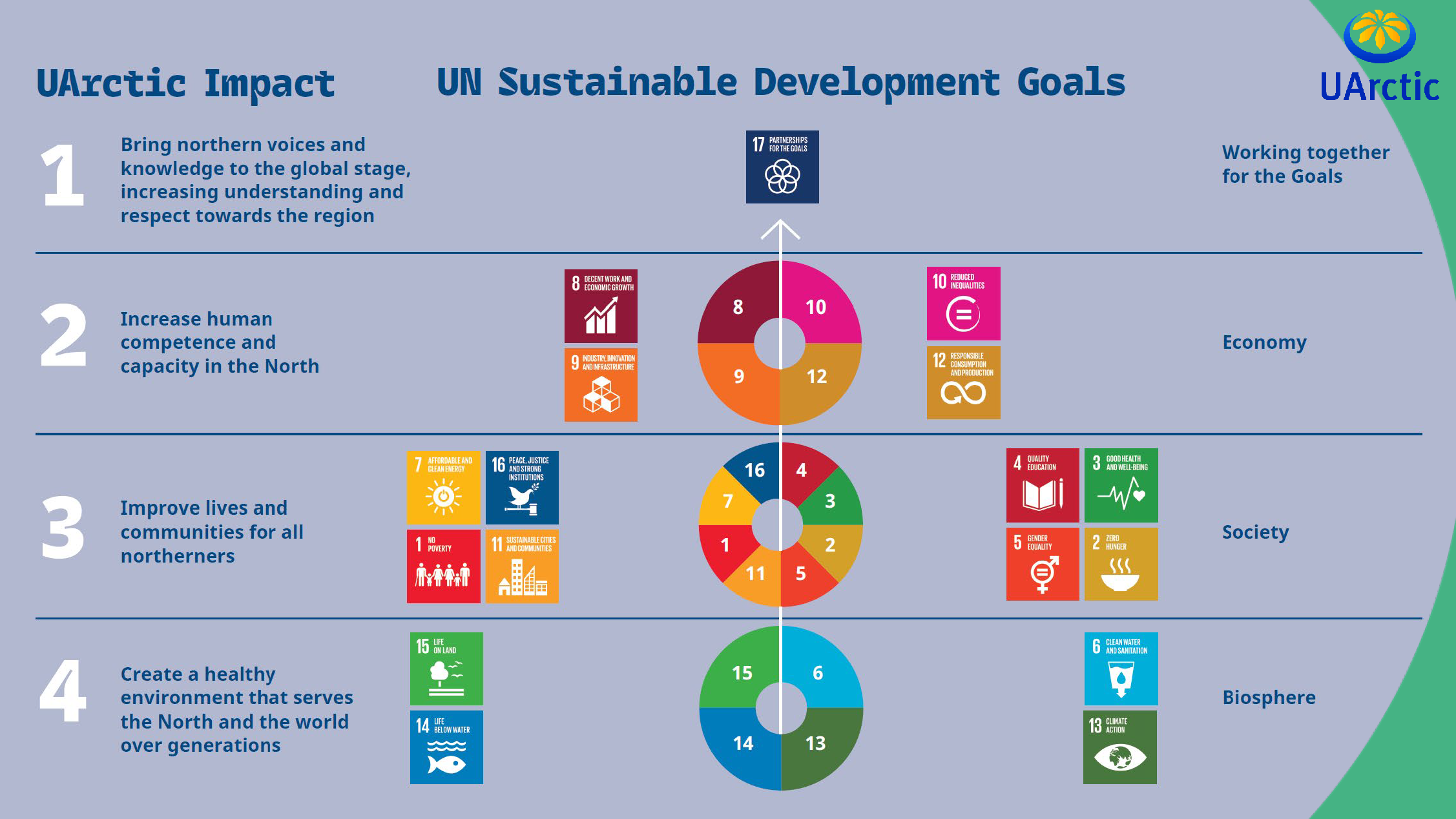
With all of this collective knowledge, it is reasonable to argue that UArctic does bring about the impacts as formulated in our Strategic Plan 2030. It is about bringing northern voices and knowledge to the global stage, and increasing understanding and respect towards the region. It is about increasing human competence and capacity in the north. It is about improving lives and communities for all northerners. And finally, it is about creating a healthy environment that serves the North and the world over generations. Hopefully, this machinery – the wealth of knowledge that is UArctic – is a suitable tool to address the impacts we want to achieve."

On December 9, 2024
Lars Kullerud, UArctic President