
Extreme 2025 Expedition: A Polyvocal Narrative to Reimagine and Protect the Arctic’s Extreme Environments

A multidisciplinary team on board the ice-class research vessel Kronprins Haakon, collaborating to explore challenging extreme environments and deepen our understanding of the Arctic's ecological significance, climate processes, and the interactions between human activities and natural systems.
On 11 November 2025, the RV Kronprins Haakon set sail from Longyearbyen dock to launch the EXTREME 25 expedition. The voyage concluded on 26 November, when the research vessel returned to Tromsø harbour. This mission was one of the key events within the EXTREMES UArctic project (UA 06/2024, from 1 January 2025 to 31 December 2026), a collaboration between UiT- The Arctic University of Norway (Department of Geosciences), the University of Copenhagen (Department of Arts and Cultural Studies), and the University of Iceland Research Centre in Þingeyjarsveit.
The focus of the expedition has been to explore the intriguing and dynamic deep-sea habitats of cold seeps and hydrothermal vents within Norwegian waters, from the Fram Strait to the Barents Sea. These distinct marine ecosystems are ecologically important due to their diverse biological and macrobiological communities and their influence on global geochemical cycles. At the same time, encountering these extreme, human-hostile environments can challenge our human-centred perspectives and inspire new ways of relating to the planet.
The concept of “extreme” inspired the planning of this multidisciplinary expedition, recognising that a scientific perspective alone cannot fully capture the complexity of these environments.
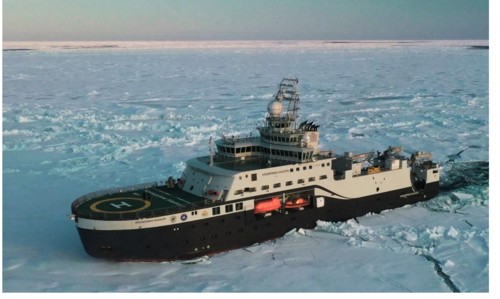
Figure 2: RV Kronprins Haakon. Photo: Dimitri Kalenitchenko (UiT)
Therefore, with over 30 participants from diverse fields, including geology, biology, micropaleontology, natural sciences, art history, sound/visual arts, illustration, and anthropology, the expedition aimed to combine scientific research with the creation of various art forms and storytelling.
Giuliana Panieri, professor of geology at the UiT - Arctic University of Norway in Tromsø and director of the Italian Institute of Polar Science, who led the project and expedition, explains, "Combining multiple disciplines enhances our ability to observe and understand the sea. This isn't just about different scientific fields but also about disciplines with diverse cultures, backgrounds, and methods. Gaining new perspectives on familiar topics can inspire us to think differently. Although multidisciplinary collaboration can be challenging, requiring openness to unfamiliar approaches, it's precisely this challenge that keeps us curious and motivated to continue".
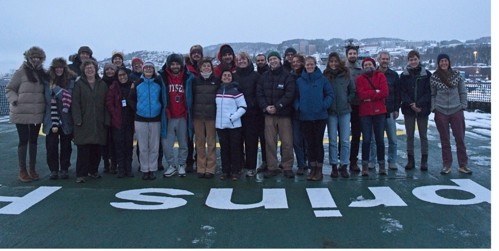
Figure 3: Extreme25 Expedition team. Photo: John Jgrzinich
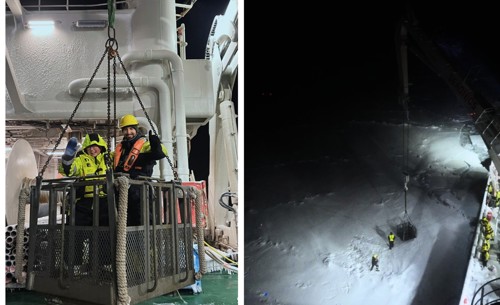
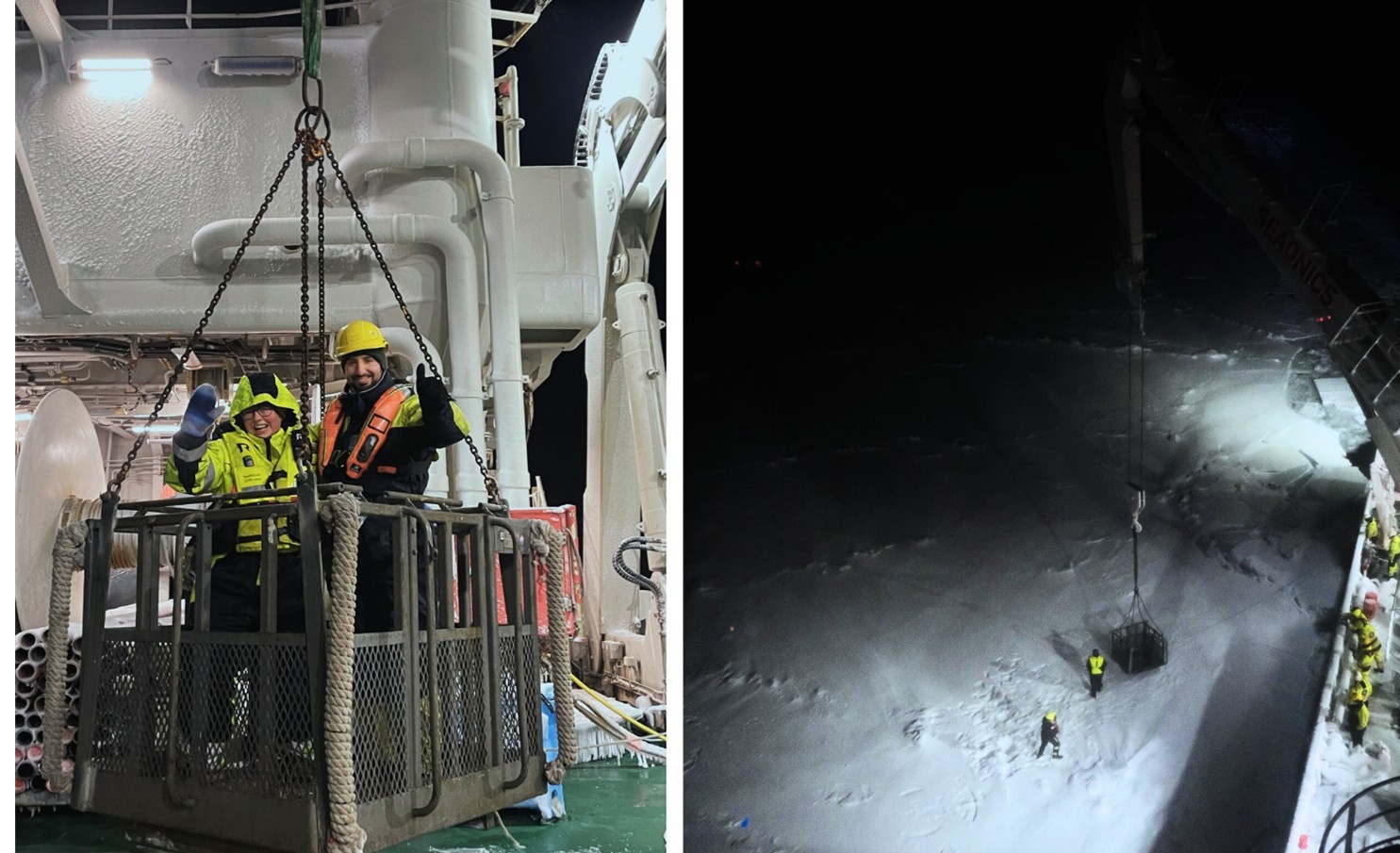
Figure 4: On the left, Mari H. Eilertsen (UiB) and Claudio Argentino (UiT) are in the transfer basket, ready to go onto the ice. On the right is the ice station. Photo: John Jgrzinich
Something has started to brew onboard, and it's only the beginning.
Over the 15-day expedition, while scientists explored life on the Arctic seabed, the artists crafted soundscapes and visual narratives that reflected humanity's dependence on the planet's extreme environments.
One of the artists who attended the expedition was Gry Bagøien, a talented Danish sound performer whose work seeks to connect humans with the Ocean through song. In the early days of the cruise, she used a speaker in the moonpool (the opening to the sea in the ship's central hangar where the ROV (remote operated vehicle) is submerge) to project her voice into the ocean, attempting to harmonise with the sounds created by the underwater robot during its dives. By employing a hydrophone to capture her vocal performance, she aimed to establish a new language that resonates with the diverse elements of the ocean, including the ROV itself, marine life, and the cold waters surrounding them. Her presence onboard culminated in a spontaneous singing performance around the moonpool, with all the expedition participants and many crew members gathered to sing for the sea and their underwater robot. A microphone recorded their song, which was then played through an underwater speaker. This performance not only aimed to reinforce our awareness of our dependence on the seas but also prompted reflection on the use of advanced technology to explore deep-sea environments that are inhospitable to humans.
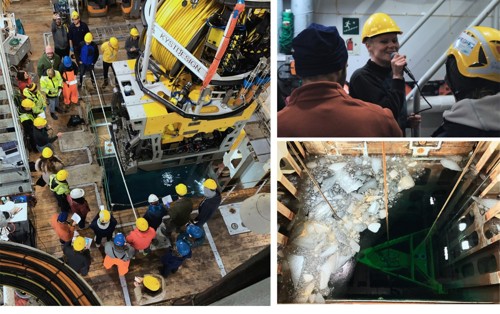
Figure 5: Gry Bagoien, crew members, and expedition participants during a singing performance around the ROV moonpool. Photo: John Jgrzinich; NORMAR/Aegir 6000ROV
The performance by Gry Bagøien is just one of the many fascinating stories from this multidisciplinary experience we are developing. We also want to share the work of Hekla Dögg Jonsdottir, a visual artist from Iceland, who has been filming long video sequences during the expedition. She aims to provide a holistic visual representation of the seascape both above and below the water, highlighting our connection to the materials and forces of the Earth that the expedition is investigating. Life above the sea is also dependent on the extreme light found on the seabed.
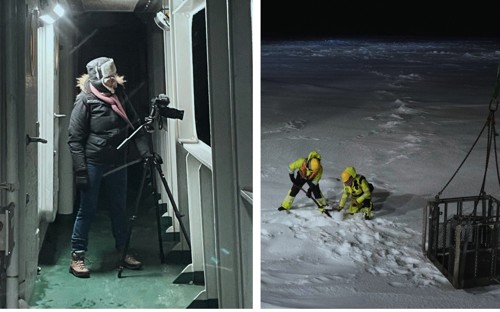
Figure 6: Hekla Jonsdottir is filming outside the vessel during ice station operations. Photo: John Jgrzinich
Another artist involved in the expedition was Jane Zimmermann, a science illustrator, who collaborated with Ann Eileen Lennert, an environmental anthropologist. Together, they are developing a creative narrative that highlights the complex connections between humanity, the living planet, and its diverse ecosystems. Their joint efforts have led to the creation of a comic titled "Exploring the Unknown," which draws inspiration from various events that occurred during the expedition. Additionally, they are currently working on an imagination book designed to engage children and young audiences, focusing on extreme environments.
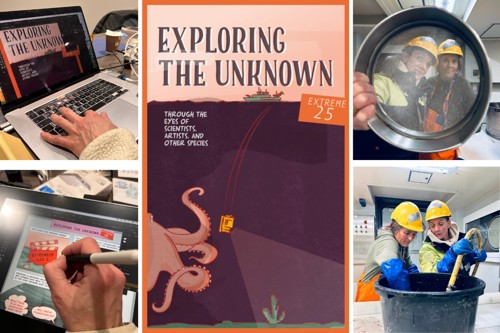
Figure 7: Jane Zimmermann and Ann Eileen Lennert assisting scientists onboard and working on the comic. Photo: Valentina Lanci.
The sound artist John Grzinich also joined the team’s expedition, aiming to explore sensory experiences through sound and listening as both observational and speculative ways of engaging with extreme Arctic deep-sea environments. Given the project's interdisciplinary nature, he is eager to promote dialogue on how scientific exploration in this setting influences broader environmental imaginaries, especially in light of the ongoing climate crisis. During the Extreme25 cruise, key themes such as 'ship as a body', 'deep sea imaginaries', and 'the technological sublime' emerged.
John worked on creating audio-visual materials that highlight scientific research aboard the RV Kronprins Haakon and the daily routines of deep-sea sampling. These works reflect the 'field aesthetics' concept explored by Michael Kjaer, art historian and assistant professor at the University of Copenhagen’s Department of Arts and Cultural Studies who also join the expedition. To illustrate his sensory approach, he also composed a short piece, 'Deep Sea Imaginaries,' performed collectively by the entire Extreme25 team on day 12 of the cruise.
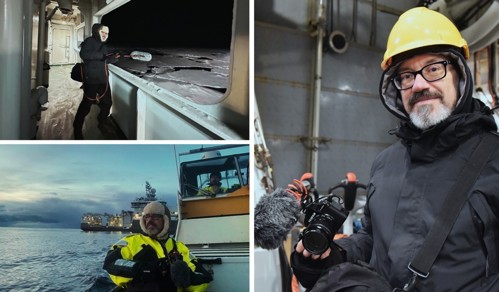
Figure 8: John Grzinich recording video and audio materials during the expedition. Photo: Michael Kjaer; Valentina Lanci
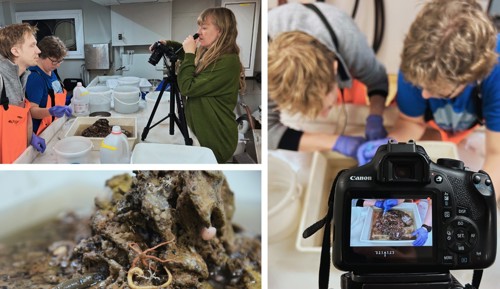
Figure 9: Thorgerdur Olafsdottir filming scientists during the sampling procedure on a carbonate rock. Photo: Valentina Lanci.
On the second leg of the expedition, Thorgerdur Olafssdottir, a visual artist from Iceland, also joins the team. She has been closely observing the scientists in the laboratories, examining the carbonate rocks, marine organisms, and waste collected from the ocean floor by the ROV. Her work explores themes of care, continuity, and the afterlives of the samples brought aboard.
Expeditions of this nature serve as a laboratory for exploring the meaningful intersection of science, art, anthropology, and other humanistic disciplines. This collaborative effort across multiple disciplines could lead to deep insights into extreme environments by combining different perspectives. It redefines our understanding of these habitats, develops new storytelling and visions, enhances the life-onboard experience, and provides innovative sensory experiences that facilitate engagement with and appreciation of these environments.
The art and performances developed during the expedition will be further refined into structured pieces for an art exhibition scheduled for October 2026 in Iceland. This upcoming exhibition, inspired by the Extreme 25 cruise, aims to engage the public, attract a wider audience, and raise awareness about the importance of understanding the unique features of extreme marine environments. We look forward to seeing the creative works that these artists, inspired by these extreme habitats, will contribute to the exhibition.
To stay updated about EXTREMES UArctic, visit the project website: https://uit.no/project/extremes and the project Instagram page: @extremes_arctic.
About the EXTREME25 expedition
The EXTREME 25 expedition adopts a multidisciplinary approach, bringing together scientists, students, media experts, and artists from around the world to explore extreme environments. This research cruise stands out not only for its scientific results but also for the breadth of expertise on board. Alongside geologists, geophysicists, geochemists, methane specialists, and marine ecologists, the expedition hosted: an active delegation from the National Research Council of Italy (CNR), representing multiple institutes and disciplines; a team of chemists and engineers from Woods Hole Oceanographic Institution; researchers from EXTREMES, a UArctic-supported initiative exploring the intersection of aesthetics, art, and science; scientists from the University of Bergen contributing expertise in deep-sea chemosynthesis-based ecosystems; scientists from University Milano Bicocca supporting the high-resolution mapping effort; microbiologists from University of Naples Federico II; micropalaeontologists from University of Vienna; anthropologists and artists studying human–polar interactions and new modes of science communication.
Explore the StoryMap Expedition to learn more about the EXTREME 25 Expedition: https://storymaps.arcgis.com/stories/b646a515db214abcb8320035f0cd12ee