
Project Report: Microscopic dragons and penis worms in focus during ScaliFar – a UArctic funded Workshop and PhD Course in the Faroe Islands

The ScaliFar PhD course and workshop participants
PHOTO: ScaliFar ProjectDuring the summer of 2026, a UArctic funded workshop and PhD course ScaliFar brought students from across the world to study animal group Scalidophora in Faroe Islands.
A unique event took place in the Faroe Islands during the summer of 2026. For the first time ever, students from across the world could gather for a PhD course, focusing exclusively on the animal group Scalidophora – an assemblage covering the three understudied animal phyla Kinorhyncha (mud dragons), Priapulida (penis worms), and Loricifera (girdle wearers). Prior to the course, an international team of researchers gathered on the islands to carry out the first intensive studies of the Faroese Scalidophora fauna. The project was entitled ScaliFar, and was funded by the UArctic Networking Activities call.
All three scalidophoran phyla are marine organisms living in the bottom sediments, and as primary consumers they represent the important food-chain link between bacteria and other larger marine animals. Mud dragons are microscopic animals that, despite their modest size, resembles tiny dragons. The Faroese mud dragon fauna has never been studied in depth, and they were selected as the main target for our surveys, because their biodiversity was expected to represent an interesting mix of Arctic species, and species adapted for the warmer, central Atlantic waters. The penis worms are larger than the mud dragons, and size-wise they represent an impressively great size range, from only a few millimetres to more than 10 cm. The target species was the North Atlantic Priapulus caudatus. The species is found widespread throughout the Northern Hemisphere, but always in low numbers. Even though it has been known for centuries, we know very little about their larval development, thus the aim was to collect a range of different developmental stages, in order to understand the morphological transition from small, plate-covered larva to the large, worm-shaped adult form. The third phylum, the girdle wearers, is one of the most recently discovered animal phyla, described less than 50 years ago. They are notoriously rare, and we were therefore not expecting to find any, but would still carry out a focused search, hoping to recover the presence of this otherwise dark taxon in Faroese fjords.
The workshop
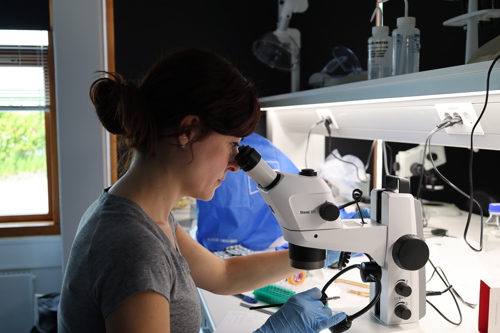
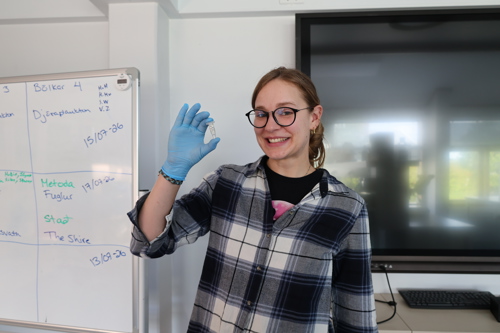
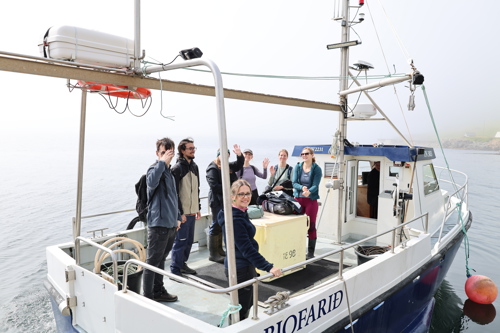
The first half of ScaliFar was a research workshop, that focused on sampling and examination of the target taxa in the fjords of Streymoy and Eysturoy, and the strait separating the two islands. The workshop team was composed of international experts from five different countries and local researchers from the University of the Faroe Islands, the Faroe Islands National Museum, and the marine consultancy company Biofar. Through the first week, we sampled four fjords, plus Sundini (the Streymoy and Eysturoy), with a total of 23 stations. The sampling revealed an overwhelmingly rich mud dragon fauna, with several hundreds of specimens. In the lab at the University of the Faroe Islands, the specimens were sorted to genus- or species level. Selected representatives for each putative species and sampling station were subject to immediate DNA extraction for subsequent molecular barcoding, and the remaining specimens were fixed for microscopic preparation. The sampling of penis worms also resulted in a decent amount of different larval developmental stages, and when merged with previously collected material, they will contribute to our understanding of priapulid development. As expected, no girdle wearers appeared in the samples.
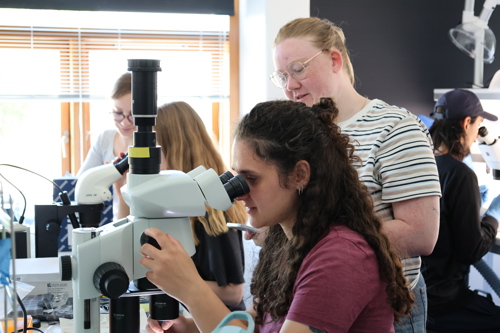
Besides the scientific component, the workshop team supported an ongoing bachelor course in Marine Biology, organised by the University of Faroe Islands. Through two intensive days, the Faroese bachelor students were introduced to the marine microfauna, inclusive field collecting, sample processing, and observation of live animals under the microscope.
The PhD Course
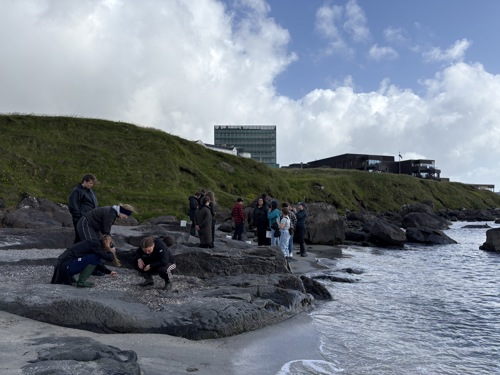
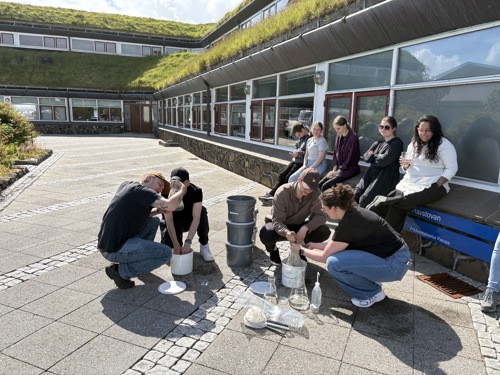
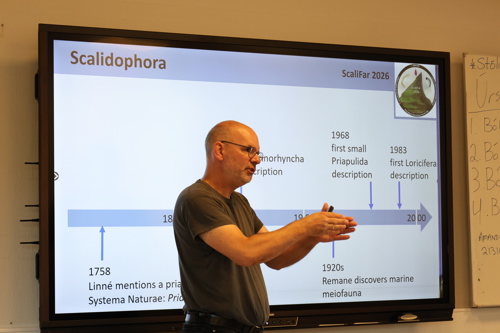
By the beginning of the second week, ten students from seven different countries, some as far away as South Korea and Brazil, arrived to Tórshavn. This instantiated the secon component of ScaliFar – the PhD course. The students came in with backgrounds, from students who were already well submerged in Scalidophora focused PhD projects, to students with a general interest in the Arctic marine microfauna. The course was generally structured so that each morning would be lecture based, whereas the afternoon would focus on field sampling from boat, sample processing, or observation of live samples in the lab. The lectures involved all PI’s from the workshop team, and represented a broad variety of topics, from Faroese history, marine biology and hydrography, to general method lectures on methodology, global biodiversity inventories, and advanced microscopy, and finally to classes focused on Scalidophora taxonomy, ecology and population genetics.
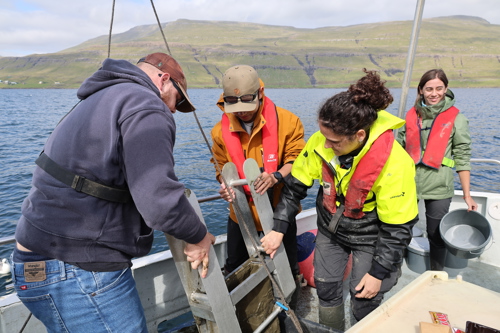
Sampling was carried out along a transect through the Kaldbak Fjord, and during the sampling days, the students got introduced to qualitative and quantitative sampling, and the differences between the two approaches. Again, the marine sediments were generous and delivered an abundant and diverse scalidophoran fauna.
All in all, ScaliFar was a great success, way beyond any expectation. The subsequent feedback from the students was extremely positive, and the workshop reinforced the collaborative bands within the Scalidophora community, and created a new, strong connection with the Faroese research community. Initially, ScaliFar was thought to be a one-time event, but now, when looking back at the results, and especially after listening to the student feedback, we consider if it is something we should do again in a few years from now.
\Martin V. Sørensen and the ScaliFar PI Team
Text: Martin V. Sørensen
Photos: ScaliFar Project
The funding for the project is based on the Kingdom of Denmark DAHES 2025 grant administered by Ilisimatusarfik for UArctic.