
Staff exchange report - Professor Mikhailova's exchange in Anchorage, Alaska

Ekaterina Mikhailova, Associate Professor in Border Studies at the UiT The Arctic University of Norway (UiT), recounts her visit to the University of Alaska Anchorage (UAA) on September 15-21, 2025, as part of north2north staff mobility scheme.
My mobility exchange in Anchorage was a wonderful opportunity for professional exchanges both with the University staff, representatives of Alaska Natives from the Unangan (Aleut), Iñupiat and Denaʼina Atabaskan communities and organisations relevant to my academic interests based in Anchorage including the Anchorage Museum, the Smithsonian Arctic Studies Centre and the Aleut International Association.
I would like to give my special thanks to Diane Hirshberg, the Director of the Institute of Social and Economic Research (ISER), for being a wonderful host and for facilitating my acquaintance with colleagues at the UAA and elsewhere in Anchorage. I want to thank also the UAA Humanities librarian Taylor Keister for his precious help with finding the literature relevant to my research topics within the extensive collection of the UAA Consortium Library.
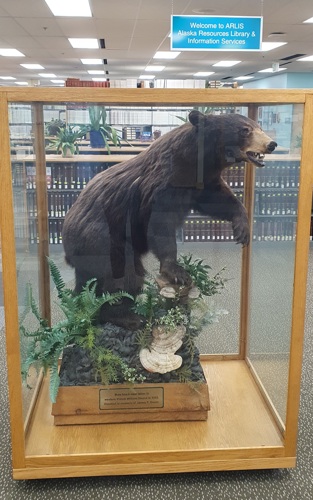
[Fig. 1: Researching alongside the wildlife at the UAA library]
Besides meeting with colleagues and working in the library during my one-week stay, I gave a guest lecture on borders and their representations in the Circumpolar North within the “Environmental Health Course” led by Prof. Philippe Amstislavski. My department at the UiT, the Barents Institute, is located in Kirkenes next to the Norwegian-Russian border. By bringing experiences from the Norwegian-Russian borderland to the classroom, I stimulated a discussion with students and the course leader about everyday life at the US-Russian borderland.
Over the weekend, I had a chance to explore the city and its surroundings. One of my areas of expertise is reclamation of indigenous place names. It was a fantastic chance to explore the local toponymic environment and discover signs with indigenous place names in Anchorage and its vicinity.
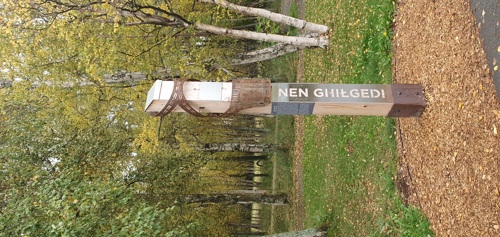
[Fig. 2: Finding the Indigenous Place Name Sign in the Earthquake Park]
In conclusion, I would like to highlight that my north2north visit to the UAA has brought several concrete outcomes. Firstly, thanks to my acquaintance with Anchorage’s Indigenous Place Naming Movement, I refer to their practices of making the toponymic landscape more just and inclusive in my recent science communication publication. Secondly, the research conducted during the north2north stay contributed to my recently submitted funding application combining Border Studies and Indigenous Studies. Finally, my participation in this staff mobility scheme allowed to expand my professional network.