
UArctic Thematic Network on Arctic Plastic Pollution joins research cruise to tackle abandoned, lost, or otherwise discarded fishing gear in Norway

An international group of researchers and participants from authorities and other organisations gathered onboard UiT The Arctic University of Norway research vessel “Helmer Hanssen” for a workshop and clean-up operations focused on abandoned, lost or otherwise discarded fishing gear (ALDFG) in Arctic Norway.
The workshop was part of the “Collaboration for research and education addressing marine pollution and clean-up operations in the Arctic and sub-Arctic areas” project, funded by the Norwegian Ministry of Education and Research. The project aims to bring together international partners to address marine plastic littering and clean-up in Arctic and sub-Arctic regions. The research cruise was the second workshop of this project, which is part of the activities of the UArctic Thematic Network on Arctic Plastic Pollution. The workhop took place from 3rd to 9th of November 2026.
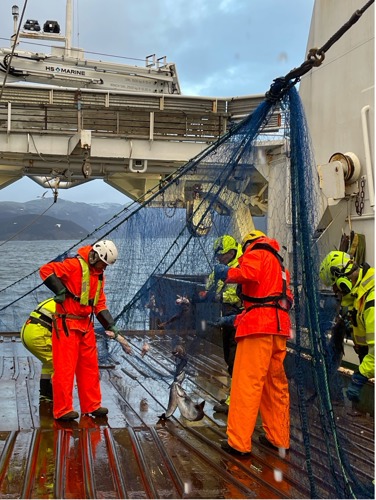
Photo: Kristine Cerbule
The project’s first workshop took place in Orkney (Scotland) earlier this year and was organized together with Heriot-Watt University. The first workshop brought together researchers, fisheries organisations, island authorities and NGOs to discuss marine plastic litter, particularly the pollution associated with beach litter. The present workshop in Norway in turn combined marine litter retrieval from the sea with observations; specifically focusing on fisheries-related marine litter, knowledge exchange and networking activities.
The operation took place in northern Norway, with the retrieval work guided by Norwegian Directorate of Fisheries (senior advisor Gjermund Langedal) which has a long experience in ALDFG retrieval operations (read more here). Participants represented international network of universities, public authorities, research institutions and non-governmental organisations. Specifically, the group included representatives from UiT The Arctic University of Norway (staff and students), Heriot-Watt University, Tromsø Municipality, the Norwegian Directorate of Fisheries, Greener Orkney, the Scottish Islands Federation, Aarhus University, the Greenland Institute of Natural Resources, Memorial University of Newfoundland in Canada, and GRID-Arendal.
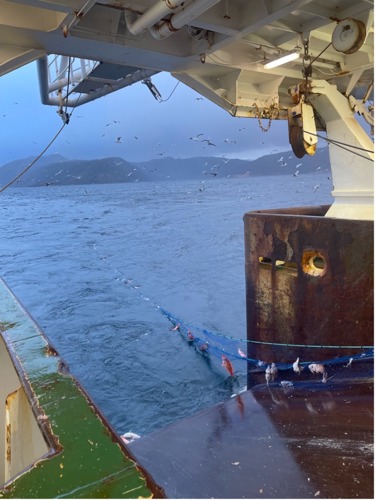
Photo: Kristine Cerbule
The practical work provided an opportunity not only to remove potentially harmful fishing gear from the marine environment, but also to improve and share knowledge about how ALDFG can be located, retrieved, documented and monitored in different Arctic and sub-Arctic waters. Therefore, the workshop provided a forum for linking experiences from Norway, Scotland, Greenland, and Canada. The workshop onboard R/V “Helmer Hanssen” was, therefore, an opportunity to build international connections, share methods and experiences, and develop future collaboration to address marine litter and ALDFG across the Arctic and sub-Arctic.
As the project moves forward, the experiences from both Orkney and Norway workshops will help for continued cooperation between the participants. The project demonstrates that addressing marine pollution requires collaboration across borders and sectors, and that practical fieldwork, research, education and local knowledge all have an important role to play.
The project is funded by Norwegian Ministry of Education and Research funding for Project Collaboration with the University of the Arctic and runs from 2025 to 2027.
By Assistant Professor Dr. Kristine Cerbule, Sustainable Fisheries and Aquaculture Heriot-Watt University, Orkney Campus.